AI Blog Writing Checklist for Pet Businesses

AI Blog Writing Checklist for Pet Businesses
Follow these 5 essential principles to create AI-assisted blogs that rank, read naturally, and build trust with your pet business audience.
It’s Okay to Use AI for Blogs
Google’s message is clear: it’s not how you create your blogs, but whether they help users. What matters is quality, helpfulness, and relevance, not the tools behind it.
AI can be your most loyal assistant in blog creation when used with the right strategy. Use PetBizAI to support your writing process, but always layer in your real-world experience.
👉 Learn more about Google’s stance on AI blogs in our PetBizAI Knowledge Hub.
1. Inject Your Experience
AI can write words, but it can’t walk dogs, groom clients’ pups, or treat recovering pets. That’s your unbeatable advantage.
Your personal stories, client results, and lessons learned add the “Experience” in E-E-A-T that AI alone can’t replicate.
With Personal Experience (Great Example):
“When I worked with a nervous spaniel recovering from surgery, I adjusted our hydrotherapy routine to shorter, calmer sessions. Within two weeks, her mobility and confidence improved, showing how small changes can transform recovery results.”
Generic AI Blog (Poor Example):
“Hydrotherapy can help dogs recover from injuries. Shorter sessions may be beneficial for some dogs.”
💡 Tip: Share specific stories, real client examples, and what you’ve learned through experience. These details build trust and authority.
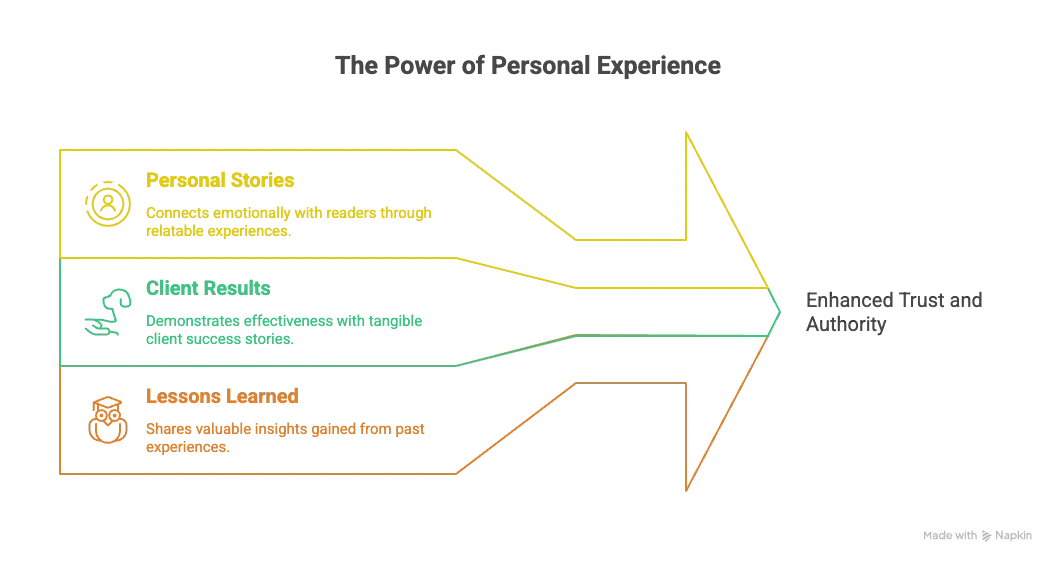
The Power of Personal Experience” showing three coloured arrows — Personal Stories, Client Results, and Lessons Learned — merging toward a single outcome labelled Enhanced Trust and Authority.
2. Be Precise, Cut the Fluff
Forget word counts and focus on clarity. Pet owners (and Google) prefer direct answers over long explanations.
Structure your blogs so each H2 or H3 directly answers a question.
Good Structure: H2: How Often Should You Bathe Your Dog?
Most dogs need a bath every 4–6 weeks, depending on coat type and activity level. Over-bathing can dry out the skin, so use a gentle, dog-specific shampoo.
Poor Structure: H2: Dog Bathing Tips
Bathing your dog is an important part of grooming. There are many ways to do it and different shampoos you can use…
🎯 Frame every H2/H3 as the exact question a pet owner would ask, then answer it immediately. This improves your chances of appearing in AI Overviews, ChatGPT Search, and Perplexity results.
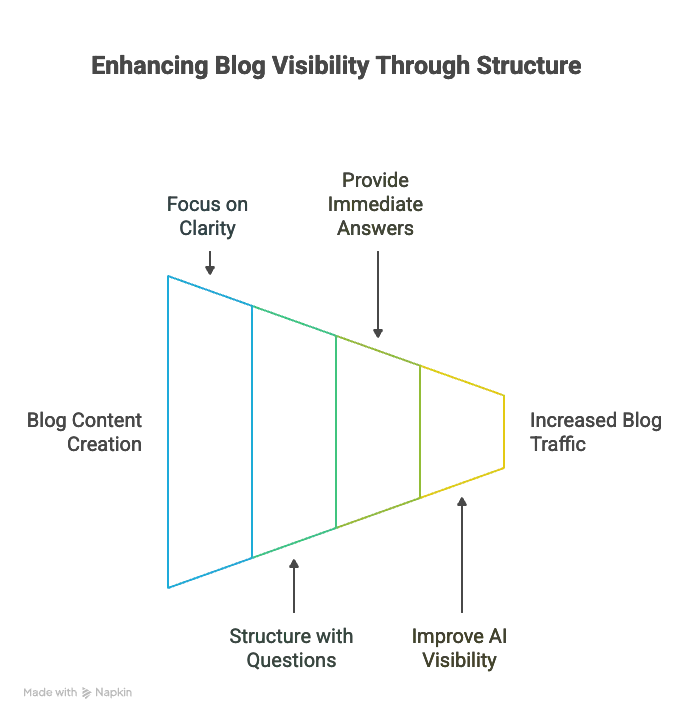
A funnel-shaped diagram showing how clear structure enhances blog visibility. It moves from “Blog Content Creation” on the left to “Increased Blog Traffic” on the right, with four key actions inside the funnel: Focus on Clarity, Structure with Questions, Provide Immediate Answers, and Improve AI Visibility.
3. Write at an 8th-Grade Reading Level
This isn’t about simplifying your ideas. It’s about making them easy to read. Most pet owners prefer straightforward, friendly language.
8th-Grade Level (Good Example):
“Regular grooming keeps your dog’s coat healthy and helps you spot skin problems early.”
Over-Complicated (Bad Example):
“Routine grooming practices facilitate the proactive identification of dermatological irregularities in canines.”
💡 Use PetBizAI’s readability checker or Hemingway Editor to check your tone and clarity.
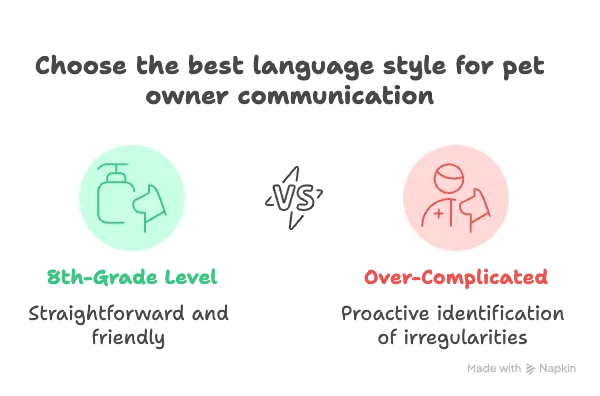
A comparison graphic titled “Choose the best language style for pet owner communication.” It shows two icons side by side: one green circle labeled 8th-Grade Level – Straightforward and friendly, and one red circle labeled Over-Complicated – Proactive identification of irregularities.
4. Back Up Statements with Data
Every claim in your blog should be backed by facts or research. This builds credibility with pet owners and with Google.
With Data & Source (Good Example):
“According to the PDSA Animal Wellbeing Report 2024, 34% of UK dog owners admit they don’t walk their dogs enough, highlighting the growing need for professional dog walking services.”
Without Data or Source (Poor Example):
“Many people don’t walk their dogs enough, which means dog walking services are in demand.”
Always cite credible, up-to-date sources, especially for health, training, or nutrition topics. Link to veterinary studies, trusted pet organisations, or official reports.
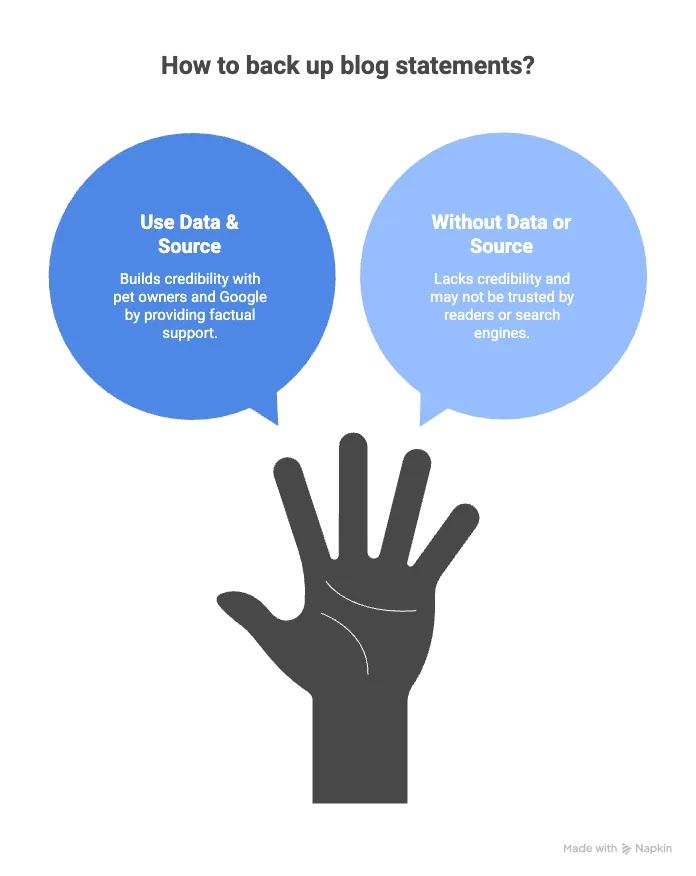
An illustration titled “How to Back Up Blog Statements?” showing a raised hand with two speech bubbles. The left bubble, labeled Use Data & Source, explains that citing data builds credibility with pet owners and Google. The right bubble, labeled Without Data or Source, warns that lacking evidence reduces trust from readers and search engines.
5. Add Supporting Visuals
Remember: your readers are pet lovers, not robots. Break up your blogs with helpful visuals that add meaning.
Use:
-
Photos of real pets (with owner consent)
-
Step-by-step screenshots or diagrams
-
Short video clips
-
Infographics made in PetBizAI’s Image Generator or tools like ** Napkin AI**
🐾 Visuals make your blogs easier to read, more shareable, and more likely to be cited in AI-powered search results.
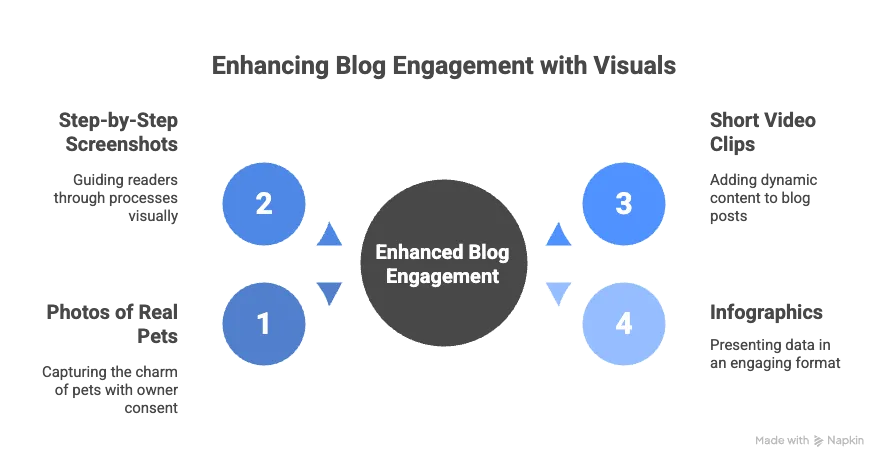
A circular diagram titled “Enhancing Blog Engagement with Visuals,” surrounded by four icons. The diagram highlights four ways to boost engagement: 1. Photos of Real Pets, 2. Step-by-Step Screenshots, 3. Short Video Clips, and 4. Infographics.
Learn to Rank #1 with PetBizAI
PetBizAI helps pet business owners write high-ranking blogs, social posts, and website copy using AI the right way by blending data, expertise, and personality.
👉 Visit petbizai.app to explore our free AI blog tools and learn how to write posts that attract pet owners and rank in AI search.
Kirsty Skeates is the founder of PetBizAI, a platform built to help pet business owners confidently use AI to save time, create content, and grow their businesses. After years of running her own pet company, she realised many owners struggled to keep up with marketing and SEO while managing day-to-day operations.
With the rise of AI-driven search and Answer Engine Optimization (AEO), Kirsty created the ** PetBizAI Blog Writer Checklist** to help business owners stay visible in a changing digital world. The checklist blends her real-world pet industry experience with AI-powered writing strategies — making it easier to produce blogs that not only engage readers but also perform well in AI search results.

About the author: Kirsty Skeates
Kirsty Skeates is the founder of PetBizAI. She has 10 years in the pet industry, including five years running Fit4DogsUK, a canine hydrotherapy and rehabilitation clinic in Beverley, East Yorkshire. She builds websites and AI tools for independent businesses and speaks at Pet Industry Federation events on AI adoption. Every guide is written or reviewed by Kirsty.