Blog / Pet Business Legal & Policies
Dog Groomer Terms and Conditions Template (UK)
If you run a dog grooming business in the UK, having clear Terms and Conditions in place isn’t optional - it’s essential. Whether you work from a salon, a mobile van, or a client’s home, your T&Cs set the rules of every appointment before a client ever walks through the door. This guide gives you a practical template covering every key section a dog grooming business needs, in plain English plus guidance on how to customise it for the way you actually work.
Kirsty Skeates Petbizai
“Clear Terms and Conditions protect both the groomer and the dog. They set expectations before the appointment even begins.”
Why Do Dog Groomers Need Their Own Terms and Conditions?
Dog groomers need specific Terms and Conditions because grooming carries unique risks that generic business T&Cs simply don’t cover. You are handling other people’s animals, using professional equipment, and making decisions about coat condition, health, and safety during every appointment. Without clear written terms, disputes over coat cuts, reaction to products, matting fees, or post-groom injuries have no agreed framework to resolve them.
A dog grooming T&C document protects both you and your client - and makes it clear from the start that you run a professional business.
What Should a Dog Groomer’s Terms and Conditions Include?
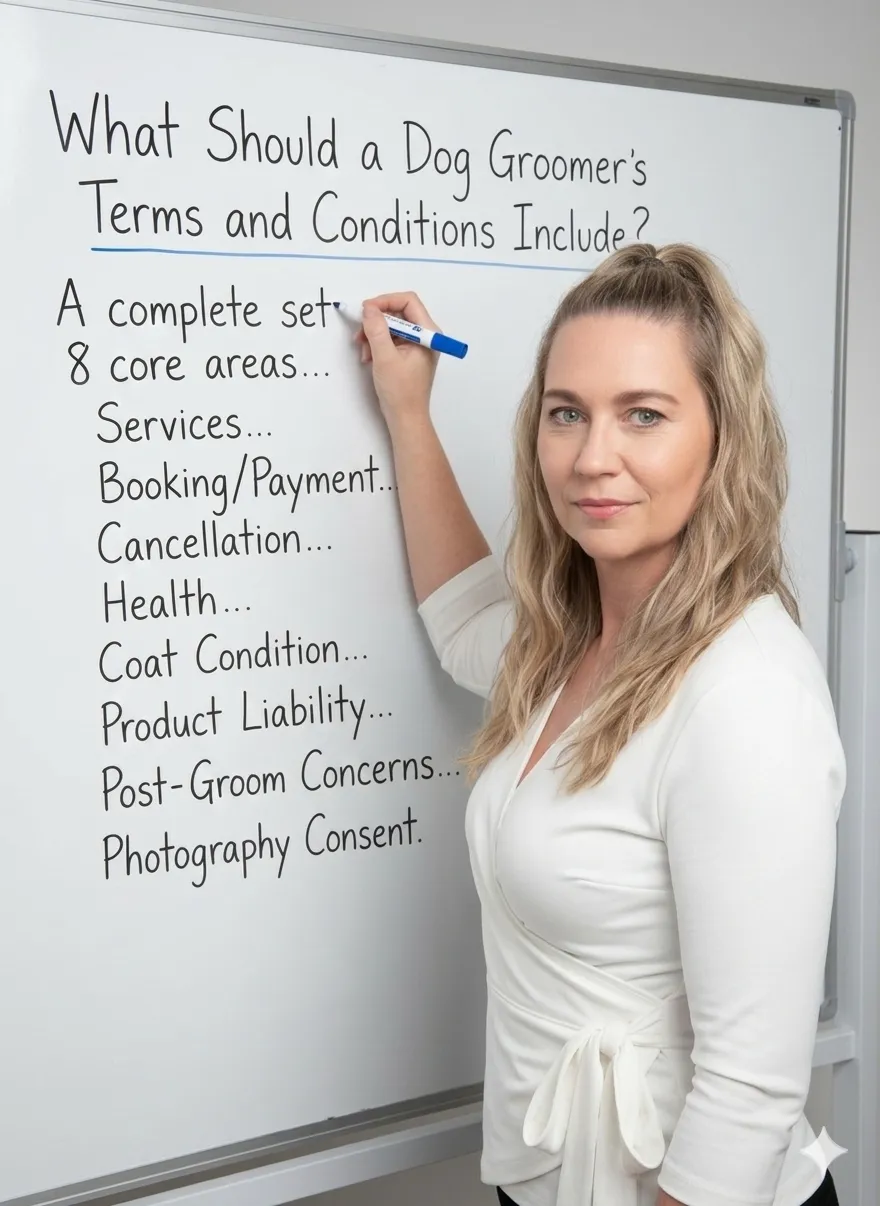
A complete set of dog grooming T&Cs should cover eight core areas: services, booking and payment, cancellation policy, health and vaccination requirements, coat condition and matting, product liability, post-groom concerns, and photography consent. Each section needs to reflect your specific services and policies - not a one-size-fits-all template.
Here is what each section should address:
1. Services Provided
This section defines exactly what your grooming service includes. Be specific - vague descriptions lead to client expectations that don’t match what you deliver.
Include:
-
Which breeds and coat types you accept
-
Which services are included in your standard groom (bath, blow-dry, trim, nail clip, ear clean, etc.)
-
Which services cost extra (de-shedding, de-matting, anal gland expression, etc.)
-
Any breeds or dogs you don’t accept (for example, certain brachycephalic breeds or large breeds beyond a weight limit)
-
Whether you offer mobile grooming and how that affects your terms
Example wording: “Our standard full groom includes a bath using professional grooming shampoo, blow-dry, brush-out, breed-appropriate trim, nail clip, and ear clean. Additional services such as de-matting, de-shedding treatments, and teeth brushing are available at an additional charge and will be discussed and agreed before the appointment.”
2. Booking, Payment, and Deposits
This section sets out how clients secure an appointment and when payment is expected.
Include:
-
Whether you require a deposit to confirm a booking (and how much)
-
Whether deposits are refundable or non-refundable
-
When the balance is due (on the day, in advance, etc.)
-
Accepted payment methods
-
What happens if a client fails to pay
Example wording: “A non-refundable deposit of [amount] is required to secure your appointment. The remaining balance is due on the day of your appointment. We accept payment by cash, bank transfer, and card.”
3. Cancellation and No-Show Policy
This is one of the most financially important sections for a grooming business. A last-minute cancellation or no-show costs you a full appointment slot with no income. Your T&Cs must make your policy clear before a client books.
Suggested structure:
-
Cancellations with 48+ hours notice: deposit returned or rescheduled at no charge
-
Cancellations with less than 24 hours notice: deposit forfeited
-
No-shows: full grooming fee charged
-
Repeated late cancellations: right to refuse future bookings
4. Health and Vaccination Requirements
You have a duty of care to every dog in your salon or van - which means setting minimum health standards for every dog you accept.
Your T&Cs should require:
-
Up-to-date vaccinations (specify: distemper, parvovirus, kennel cough as a minimum)
-
Flea and parasite treatment
-
Disclosure of any known skin conditions, allergies, or medical history
-
Disclosure of any behavioural issues (biting, aggression, anxiety)
-
Your right to refuse or stop a groom if a dog appears unwell
Important: State clearly that if a dog arrives with fleas, you reserve the right to treat them and charge accordingly - or to refuse the appointment.
5. Matting and Coat Condition
This section is unique to dog groomers and often causes the most disputes. Matted coats require different handling, more time, and in severe cases, a close clip that the client may not expect. Your T&Cs must address this before it becomes a confrontation.
Include:
-
Your right to assess coat condition on arrival
-
That severely matted coats may require a close clip for welfare reasons
-
That de-matting carries an additional charge
-
That prolonged de-matting is not carried out where it would cause distress to the dog
-
That you are not liable for skin conditions revealed beneath a matted coat
Example wording: “In cases of severe matting, [Business Name] reserves the right to clip the coat short where de-matting would cause the dog undue stress. Additional de-matting fees apply. We are not liable for any skin irritation or conditions revealed following the removal of matted fur.”
6. Product Liability and Allergic Reactions
Even professional, veterinary-approved grooming products can cause reactions in some dogs. Your T&Cs should include a clause that covers your position if a dog has a skin reaction after a groom.
Include:
-
A list of products you use (or state that products are professional-grade and veterinary approved)
-
That clients must disclose known allergies or sensitivities before the appointment
-
That you are not liable for reactions where no allergy was disclosed
-
That if a reaction is disclosed, you will accommodate reasonable alternative products where possible
7. Post-Groom Concerns
Clients sometimes contact groomers days after an appointment with concerns about a cut, a nick, or a skin issue. This clause sets out your process for handling post-groom queries.
Include:
-
How quickly concerns must be raised (for example, within 24-48 hours)
-
Your process for reviewing concerns (asking for photos, inviting the client back)
-
That minor nicks and irritation are a known risk of grooming, particularly in dogs with sensitive skin or behavioural issues during the groom
-
That you are not liable for pre-existing conditions that were not disclosed

8. Photography and Social Media Consent
Most groomers photograph their work - before and after shots are a core part of marketing. Without consent in your T&Cs, you technically need to ask every client individually.
Include:
-
That you may photograph dogs before and after their groom
-
How you use those photographs (social media, website, portfolio)
-
That clients can opt out without any impact on their service
Relevant UK Regulations Dog Groomers Should Know About
UK dog groomers operate within a framework of legislation that directly shapes what your Terms and Conditions need to cover. Referencing these regulations in your T&Cs strengthens your professional standing and signals to clients that you run a compliant, responsible business.
The key regulations to be aware of:
-
Animal Welfare Act 2006 - places a legal duty of care on anyone responsible for an animal, including groomers. Your T&Cs should reflect your commitment to the Five Welfare Needs, particularly around stopping a groom if a dog shows signs of distress.
-
Consumer Rights Act 2015 - governs your contract with clients, including what happens when services don’t meet the agreed standard. Your T&Cs must be consistent with consumer rights law or relevant clauses could be unenforceable.
-
UK GDPR and Data Protection Act 2018 - applies to any client data you hold, including names, addresses, and pet health records. Your T&Cs should reference your privacy policy and data handling practices.
-
Local Authority Licensing - if you operate a dog grooming business from business premises, you may be subject to local authority regulations. Check with your local council for any applicable licensing requirements in your area.
One Thing You Should Definitely Do: Before publishing your T&Cs, check that nothing in your document conflicts with the Consumer Rights Act 2015. Any clause that attempts to exclude liability for negligence, or that is considered unfair under the Act, may be unenforceable. The Citizens Advice website (citizensadvice.org.uk) has a plain-English guide to your obligations as a service provider.
Do You Need a Solicitor to Create Dog Grooming T&Cs?
The PetBizAI T&C Assistant gives you a strong, professionally worded starting point - built around your specific business. Once you have that draft, getting it reviewed by a solicitor is absolutely worthwhile, and far more cost-effective than starting from scratch.
The PetBizAI T&C Assistant at petbizai.app walks dog groomers through every section above, asks the right questions about your specific business, and generates a complete, professionally worded document in minutes. It’s built for pet businesses in the UK and requires no legal knowledge to use.
Note: For specific legal disputes or complex business arrangements, always seek qualified legal advice.
How Do You Get Clients to Sign Your T&Cs?
The most reliable method is to include T&Cs in your booking confirmation and require clients to actively tick a box confirming they have read and agreed to them. This creates a clear record of consent.
Options include:
-
A tick box on your online booking system
-
A PDF sent with your booking confirmation email that clients sign and return
-
A physical form completed at the first appointment
-
A link in your booking confirmation to your T&Cs page with a required confirmation tick
Avoid simply publishing T&Cs on your website and assuming clients have read them - a specific confirmation step is far stronger.
Ready to create your dog grooming T&Cs?
Try the T&C Assistant at petbizai.app - built specifically for UK pet businesses.
No legal knowledge required, takes around 10 minutes.
Part of the Pet Business Terms & Conditions Series
If you run a pet business in the UK, clear Terms and Conditions protect both you and your clients. This article is part of our Pet Business Legal Guide series, designed to help pet professionals create policies that are clear, fair, and legally sound.
Featured
[
](/blog/pet-business-terms-and-conditions-mistakes)
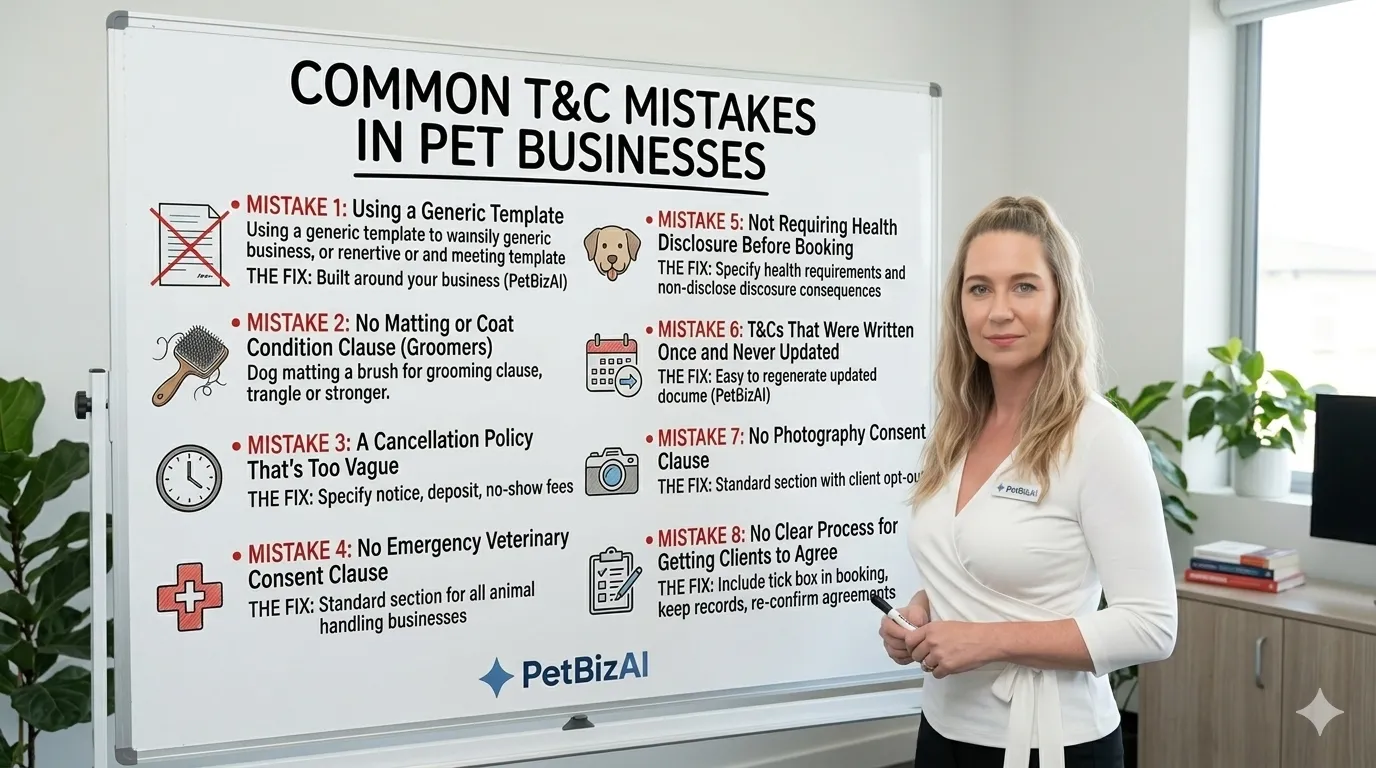
Common Terms and Conditions Mistakes Pet Businesses Make (And How AI Fixes Them)
Many pet businesses have Terms and Conditions, but they’re often copied, outdated, or too vague to offer real protection. This guide explains the most common T&C mistakes pet businesses make and how clearer policies or the PetBizAI T&C Assistant can help prevent disputes around cancellations, payments, and client expectations.
[
](/blog/dog-groomer-terms-and-conditions-template-uk)
Dog Groomer Terms and Conditions Template (UK)
Learn what dog groomer terms and conditions should include in the UK. This guide explains the 8 essential policies every grooming business should have, from cancellations and matting to liability and client consent.
[

](/blog/dog-groomer-terms-and-conditions-uk)
How to Use the PetBizAI T&C Assistant: A Step-by-Step Guide
Learn what dog groomer Terms and Conditions should include in the UK. This guide explains the 8 essential policies every grooming business needs — from cancellations and matting to liability and client consent — and shows how to create your own T&Cs in minutes using the PetBizAI assistant.

About the author: Kirsty Skeates
Kirsty Skeates is the founder of PetBizAI. She has 10 years in the pet industry, including five years running Fit4DogsUK, a canine hydrotherapy and rehabilitation clinic in Beverley, East Yorkshire. She builds websites and AI tools for independent businesses and speaks at Pet Industry Federation events on AI adoption. Every guide is written or reviewed by Kirsty.